
Dr. Universe

Ask Dr. Universe – Robots

Dr. Universe, When can I own a robot? – Jack, 8, Taos, New Mexico

Dear Jack,

There are all kinds of robots in our world. In fact, you may already have one in your house.

That’s what I found from my friend, Professor Matthew E. Taylor. We met up at Washington State University’s Artificial Intelligence Lab, where engineers are exploring how robots learn and work.

“One thing a lot of people don’t realize is there’s not really a good definition for what a robot is,” Taylor said. “It’s really just something that senses the world around it and then acts on it.”

Think about an automatic garage door, for example. It senses when you push a button and if something is in the way. Then, it moves up and down, Taylor explains.

I’d actually had an idea for a robot of my own—a sidekick to help me find answers to baffling questions from humans. It would also deliver tuna fish sandwiches.

As Taylor and I tinkered with microchips, wires, and computers, he explained what it takes to build a robot.

“There’s the mechanical engineering, figuring out how the robot will actually move,” he said. “There is electrical engineering, figuring out what sensors to use and how that’s all going to be wired together. There is also computer science. You have to program the robot to do what you want it to.”

You could build a robot of your own. You might be able to buy one, too. But it probably won’t be doing your laundry or cleaning up your room any time soon.

Nonetheless, some robots in our world can do some impressive jobs.

“Robots are really good at the three D’s: dirty, dangerous, and dull,” Taylor said. At WSU, engineers are building robots that can help with harvest and heavy lifting on farms.
Other robots are also good at assisting humans in their daily lives, he adds. In Japan, some scientists are building robots that look more like humans to help assist elderly people. In the lab here, one group of students is developing a robotic wheelchair to help people get around.

“One of the areas we work in is robot-human interaction, which is a combination of computer science and psychology, figuring out how humans and robots can better work together,” Taylor said.

If you are interested in building robots, Taylor suggests meeting with local clubs in your community, like LEGO First Robotics (http://www.firstinspires.org/). You can make new, human friends and enter your robot in competitions.

“Just dive in,” Taylor said. “It’s really fun, but it can be frustrating, just like any new thing. It takes a while to learn, but it is so satisfying when it works.”

My robot is still a work in progress. As we learn more about how robots learn, help us, and work, we can make them better. Perhaps one day, I won’t have to make my own tuna sandwiches anymore. Of course, even if my robot can help answer questions, I’ll still be here to answer them, too. After all, it’s my favorite thing to do.

Sincerely,
Dr. Universe

Got a science question? E-mail Dr. Wendy Sue Universe at Dr.Universe@wsu.edu. Ask Dr. Universe is a science-education project from Washington State University.
Ask Dr. Universe – Tree Rings

Why do trees have rings? -Cynthia, 8, Seattle, WA

Dear Cynthia,

While walking in the woods with my friend Gary Chastagner, we stumbled upon some old tree stumps. The stumps had so many rings we had to use our magnifying glasses to see them all.

“It’s a timeline,” said Chastagner, examining the stump. I thought it might make a nice scratch post, too.

“There is usually a single ring added each year because of the transition between the growth of the previous year and the new growth,” he said.

He pointed out that the growth rings were different colors. Some were lighter and others darker. Some were thicker while others were thinner. All these differences tell us about how the tree grew throughout its life.

Chastagner is a scientist at Washington State University and helps plants, particularly Christmas trees, stay healthy.

He said some trees actually don’t appear to have rings at all. Other trees will grow thousands of rings, if they live long enough.

In the redwood forests of California, the trunks of some trees have grown so wide it would take 25 kids holding hands to circle one. In fact, some people have found old redwood stumps with more than 3,000 rings. They’re ancient.

There’s one particular part of the tree that forms these rings each year or in some species, twice a year. In the spring, if you peel back a tree’s bark, you’ll find a slippery surface.

“That’s the cambium and it lays down the new woody cells each year,” Chastagner said.

The cells are like building blocks that produce new layers or wood. In spring, the tree grows pretty fast. The fast growth makes larger cells that form a ring with lighter color. In summer, the tree is often stressed from lack of water or heat. The cells are much smaller and form a ring that is darker.

While the color tells us what time of year the rings formed, the size and shape of the rings tell us a few other things about the tree, too.

“You can kind of look at stresses that the tree was growing under,” Chastagner said.

Often, the tree stress is related to the weather conditions. In fact, tree rings can tell us a lot about weather patterns over the years, which we call climate.

In a way, they’ve been recording weather conditions longer than humans.

If the tree has enough water, sun, and space to grow, the rings will be thicker. But if weather conditions aren’t so great, a tree might struggle for resources and grow thinner rings.

By comparing different sized rings and the tree’s age, scientists can understand more about droughts, severe storms, attacks by insects or disease, and natural disasters that happened long ago.

Trees are some of the oldest living organisms on our planet, Chastagner reminded me, as we explored the forest. While most of us spend our time admiring the outside of towering trees, we know that on the inside, trees are also leaving an amazing story of their life on Earth.

Sincerely,
Dr. Universe

Got a science question? E-mail Dr. Wendy Sue Universe at Dr.Universe@wsu.edu. Ask Dr. Universe is a science-education project from Washington State University.

Ask Dr. Universe – Liquid Nitrogen

Why is liquid nitrogen so cold? -Aaron, 9, Seattle, WA

Dear Aaron,

When I got your question, I headed straight for my friend Jake Leachman’s lab at Washington State University. He’s an engineer who knows a lot about what happens to things when they get super cold.

He showed me a thermos full of colorless, liquid nitrogen. It was about -321 degrees Fahrenheit.

We can’t see it with our eyes, but I found out about 78 percent of our air is made up of nitrogen in its gas form.

You may have heard about states of matter, like liquids, solids and gases. Liquid nitrogen is so cold because of the way molecules change as a gas turns to liquid.

Nitrogen doesn’t naturally occur in a liquid form here on Earth. Humans have to make it from air. Since air is everywhere, it’s pretty cheap. In fact, some people have said making liquid nitrogen is cheaper than making soda pop.

We funnel air into a big compressor where it undergoes a lot of pressure. The compressor pushes the molecules, or those building blocks that make up air closer together.

This compression causes the gas to heat up. While keeping the pressure high we cool it down to the temperature of the lab. Next, we allow the gas to drop in pressure. This is known as expansion.

To expand the gas, sometimes scientists will force the gas through a packed bed of sand, called a throttle. Other times they will push it through a small hole called a Joule-Thomson valve. What works best for cooling though is to have the gas do useful work during the expansion, like spinning a turbine or pushing against a piston.

When the high-pressure gas expands, or relaxes, considerable cooling happens and eventually the gas becomes a very cold liquid. In fact, most gases turn to a liquid when they cool down.

“A liquid is a state of matter where atoms and molecules are continuously bumping into and communicating with their neighbors,” Leachman said, as we put on our safety goggles and gloves. “Gases chill by relaxing. This happens when there’s freed up space and reduced pressure, or stress on them.”

In the lab, Leachman filled a balloon with air and dropped it in the liquid nitrogen. At first, I thought it would pop. But the balloon actually shriveled up, as the air inside turned to liquid oxygen and nitrogen.

When the air inside the balloon got really cold, the particles started to slow down and take up less space.

When he took the balloon out the process reversed. The balloon went back to its original shape. When the liquid boils in room temperature, the molecules in it move faster. When the molecules move faster they take up more space and the balloon gets big again.

“(Liquid nitrogen) also makes great ice cream and frozen marshmallows,” Leachman adds.

He dropped soft, fluffy mini marshmallows into the thermos. When he took them out, they were crunchy frozen. We taste tested them. In the name of science, of course.

Sincerely,
Dr. Universe

Got a science question? E-mail Dr. Wendy Sue Universe at Dr.Universe@wsu.edu. Ask Dr. Universe is a science-education project from Washington State University.

Ask Dr. Universe – Fingernails

What are fingernails made of? -Amy, 8, Seattle, WA

Dear Amy,

My claws can come in quite handy when I need to scratch my ears or climb trees. I bet you’ve found that your own fingernails can be useful tools, too. Perhaps you’ve used them to pick up a penny or peel an orange.

It turns out that while my claws and your fingernails look a little different, they are actually made out of the same thing: keratin.

That’s what I discovered when I went to visit my friend Professor Lisa Carloye, who teaches biology here at Washington State University.

As you may know, your body is made up of living cells, which make a wide variety of proteins. In fact, about 20 percent of your body is actually made up of proteins—proteins like keratin, which help cells do different jobs.

Sometimes this means building fingernails and toenails. Other times it might mean an animal will grow claws. Claws can then be used for defense, to catch prey, or climb. Keratin can also help some animals grow hooves. Horses, for example, walk on their toenails. It gives their feet a little extra support on rocky ground.

“Claws and hooves and fingernails are all basically the same thing,” Carloye said. “They are adaptations of the same process. Keratin itself is what gives fingernails their rigidity, their strength, and flexibility.”

Oftentimes, fingernails will start growing even before you are born. The process all begins underneath your skin.

If you take a look at someone’s fingernails, you may notice a small crescent moon-shape at the base. It’s called the lunula, the Latin word for little moon. Sometimes it’s easiest to see it on the thumb. The lunula is actually part of the nail called the matrix.

The matrix creates new cells, which help form new layers of keratin. Once fingernails start growing, they’ll keep on growing about two inches each year. The longest nails ever on a pair of hands were measured at more than 28 feet total.

As the fingernails grow and poke up out of your skin, the cells actually die. That’s why it doesn’t hurt to trim your nails at the top. As you may have noticed, it doesn’t hurt to get your hair cut either.

“The other place we find keratin is in hair,” Carloye said. We also find it in fur, feathers, and the top layer of human skin, she adds.

Some scientists can use fingernail clippings, or other kinds of samples that contain keratin, to learn more about what animals eat. Other scientists are curious about how nails grow at different rates and why. Perhaps one of the most devoted nail scientists was William Bean, who observed and tracked his own nail growth for more than twenty years.

We are still looking for more answers to why nails, claws, and hooves grow exactly the way they do. But now you know that keratin makes up our nails and helps them grow—slowly, but surely.

Sincerely,
Dr. Universe

Got a science question? E-mail Dr. Wendy Sue Universe at Dr.Universe@wsu.edu. Ask Dr. Universe is a science-education project from Washington State University.

Ask Dr. Universe – Snow

How does snow form? –Susan, 8, Lake City, South Carolina

Dear Susan,

It just so happens that when I looked out the window here in Pullman, Wash., everything was covered in glittering snow. I watched it fall from the sky and wondered how exactly it formed, too.

So I put on my favorite red mittens and went to visit my friend Nic Loyd, a meteorologist here at Washington State University. He studies what’s going on up in the skies.

He explained that water moves through our atmosphere in different forms all the time. Clouds are made up of tiny water droplets that have turned into a gas called water vapor. It comes from evaporated water that rises from Earth’s surface.

So, in a single snowball, you might actually find traces of water from rivers, lakes, or oceans around the world.

Sometimes cool air up in the sky will cause water drops to hang onto pieces of dust, tiny bacteria, or other things floating in the air.

When the temperature plunges, the now heavier water drops will freeze into tiny ice crystals.

“Snow occurs when lots of tiny ice crystals in clouds stick together to form snowflakes,” Loyd said.

The flakes can be made up of anywhere from two to more than 200 ice crystals.

The hydrogen and oxygen building blocks that make up water will also freeze into particular patterns that give nearly all snowflakes six arms.

While snowflakes share this trait, they can come in all kinds of shapes and sizes. In fact, you may have heard the phrase “no two snowflakes are alike.”

Some of the first humans who took pictures of snowflakes under a microscope realized snowflakes came in lots of beautiful and different patterns.

After further research, it turns out some snowflakes actually are identical. It’s pretty rare to find two that are exactly alike. But the odds of finding them go up when you consider that a block of snow, just a foot tall by a foot wide, contains an estimated million billion snowflakes.

Once snowflakes have formed up in the clouds, gravity brings them down to Earth’s surface. It’s a nearly 20,000-foot fall.

Typically, it takes about an hour for a snowflake to fall from a cloud to the ground. That is, if we don’t catch them on our tongues first.

Snowflakes are lighter than rain and they are easily blown in the wind, so the journey is longer than a raindrop’s, which takes just about three minutes.

“Snow can only reach the ground if the temperature is below freezing everywhere in the atmosphere,” Loyd added. “If snow reaches the ground that means that it was never rain at any point during its journey from the cloud.”

After I left Loyd’s lab, I plopped down in a drift to make a snow cat angel. Then I looked up to the sky again. This time knowing that no matter where you go, somewhere in the world countless tiny snowflakes are forming up in the clouds.

Sincerely,
Dr. Universe

Ask Dr. Universe – Monarch Butterflies

How far can monarch butterflies fly? -Roarna, 9, Nelson, New Zealand

Dear Roarna,

When cold winters come around, thousands of monarch butterflies begin a long journey in search of warmer weather. Some will fly more than 2,200 miles to find it.

That’s what I found out from my friend David James, a scientist here at Washington State University who is studying where monarch butterflies go.

So far, it appears that many monarchs who start their journey in Canada or the Northern U.S. head down to Mexico.

“If a Canadian monarch survives the winter in Mexico, it will fly back to Texas to breed,” James said. “That’s an additional flight of about 800 miles.”

So, it’s likely that some of the butterflies will fly up to 4,000 miles in their lifetime.

Some experts have calculated that’s about the same distance as a 150-pound person making a trip around the Earth 13,000 times. That’s like making a trip from the Earth to the moon more than 500 times.

The journey is long for monarch butterflies. They do it for survival.

“They can’t survive the cold winters in the north, so they leave for the milder climate along the California coast and into Mexico,” James said.

Before the monarchs start heading south, James and other volunteers tag the butterfly wings with an ID code on a little sticker. It’s like a butterfly license plate. Then, he depends on citizen-scientists, people who volunteer their time to help with scientific research, to keep their eyes out for the butterflies.

When people find the tags and report the ID number, it helps James and scientists get a better understanding of the monarchs’ flight pattern. While we don’t know exactly what route the butterflies take, the citizen-scientists are helping us learn more about it.

“We do know they travel 30 to 50 miles a day,” James said. “Sometimes fairly low, across the landscape. I’ve seen them crossing highways just above car-level.”

Some glider pilots have actually spotted monarchs flying hundreds of feet up in the air, James said. The butterflies will use air currents to help them travel.

They rise to the challenge of eating and sleeping along the way. While in flight, they have to keep their wings dry. They’ll stay in trees to escape the rain. Monarchs will fly during the day and in temperatures of at least 55 degrees Fahrenheit. They stop to eat nectar from flowers. At night, they’ll roost in trees.

Most monarchs will arrive in Mexico in early November. When they reach their destination, they roost with about a million other monarchs. You can spot swooping clouds of orange and black coming from the trees.

The butterflies stay in Mexico or California for the winter. Fittingly, they start to find mates in February, around Saint Valentine’s Day. They lay new eggs that hatch caterpillars. The caterpillars change into butterflies and make their way back north. It’s another long journey for a new generation of monarchs.

Sincerely,
Dr. Universe

Ask Dr. Universe – Bees

Why do bees make hexagons in their hives? Why not any other shape? -Aditya, 10, New Delhi, India

Dear Aditya,

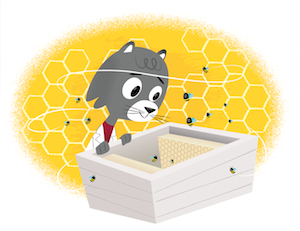
When bees make hexagons in their hives, the six-sided shapes fit together perfectly. In fact, we’ve actually never seen bees make any other shape. That’s what I found out when I visited my friend Sue Cobey, a bee researcher at Washington State University.

Cobey showed me some honeycombs where the female bees live and work. Hexagons are useful shapes. They can hold the queen bee’s eggs and store the pollen and honey the worker bees bring to the hive.Dr.U Bees

When you think about it, making circles wouldn’t work too well. It would leave gaps in the honeycomb. The worker bees could use triangles or squares for storage. Those wouldn’t leave gaps. But the hexagon is the strongest, most useful shape.

Don’t just ask the bees. Cobey explained that humans have recently used math to find out why hexagons make the most sense.

“The geometry of this shape uses the least amount of material to hold the most weight,” she said.

It takes the bees quite a bit of work to make the honeycomb. The wax comes from glands on the bees’ bellies, or abdomens. Honeybees have to make and eat about two tablespoons of honey to make one ounce of wax. Then they can add this wax to the comb as they build. A bee colony can produce 100 pounds of honey, Cobey said. In some places they can even produce 300 to 500 lbs. The structure is important to hold all this weight and protect the honey, especially during winter.

The hexagon might just save bees some time and energy. They can use the energy to do another really important job: carry pollen from flower to flower that allows new plants to grow. It’s my cat instinct to swat at a bee, but I try not to because bees are really important. They make it possible for us to eat food.

“The honey bee is an amazing animal, really fun to work with,” Cobey said. “And she is responsible for pollinating your fruits, vegetables, and nuts.”

Having a sturdy and useful hive can help bees get the job done.

Not too long ago, some scientists wondered how exactly the bees build these hexagons. They found certain bees would start out making circles in the wax using their body as a tool.

Scientists don’t really know why it happens, but the bees seem to be using their body heat to melt the wax from a circle shape into a hexagon shape.

Hexagons and honeycomb shapes are also useful for building things humans use, too, like bridges, airplanes, and cars. It gives materials extra strength.

After all, materials made with hexagon shapes can also handle a lot of force, even if they are made out of a lighter material. That’s what I learned from my friend Pizhong Qioa, an engineer and professor at WSU.

“We learned it from the bee,” he said. “Hexagons apply to almost everything you can build.”
For having never done a day of math homework in their lives, bees sure seem to use some creative geometry and engineering to build their headquarters.

Sincerely,

Dr. Universe
Find your very own field guide to bees at askDrUniverse.wsu.edu/bee-guide.

Have a question? Ask Dr. Universe. You can send her an e-mail at Dr.Universe@wsu.edu or visit askDrUniverse.wsu.edu.

Ask Dr. Universe – Spiders

Do spiders have good eyesight? -Kathryn, Comfort, Texas

Dear Kathryn,

Most spiders have quite a few eyes, but they usually can’t see very well. Then again, seeing isn’t everything. That’s what I found out when I went to visit my friend Rich Zack, a scientist at Washington State University who knows a lot about insects and spiders.

Zack explained that spiders have a number of small lenses on the top of their heads. These simple lenses let them see changes in light and dark. It’s probably a pretty blurry view, he said.
There are more than 40,000 spider species on Earth. We can often identify a spider by counting its eyes and seeing how they are arranged.

A wolf spider, for example, has three rows of eyes to help it hunt in the dark. The first row has four small eyes, the second has two large ones, and the third has two medium-sized ones.
A jumping spider has two huge eyes and two small ones on the front of its face. On top are two tiny eyes and two medium eyes. This way, it can see all around.

Some scientists are curious about how different spider eyes work. For example, the size and location of some eyes appear to help spiders see more details. Others help them see a wider view of the world, even if it’s fuzzy.
A few years ago, scientists discovered a kind of spider that lived in dark caves. It didn’t have eyes, but it didn’t really need them either.

In fact, most spiders live in the dark. We see some scurrying around during the day, but most are nocturnal, which means they move around at night.

If you pointed a flashlight in the direction of a wolf spider, you could see its eyes shining in the dark. They have iridescent layers called tapeta. Cats and other animals who have evolved to look for food at night also have tapeta to help them see better in the dark.

With or without eyes, spiders are pretty good at using their other senses to survive, too.
“Most spiders rely on smell or touch to capture prey and perceive their environments,” Zack said. “Some spiders can feel the vibrations on their webs, then move out to see if that vibration was caused by a potential item of food.”

Finding food is one big responsibility for spiders. Finding a mate is another. Jumping spiders use their bright colors to attract one.

A group of scientists thought that if these brightly colored spiders were attracting mates, then maybe the spiders saw colors, too. They found out from their experiments that some jumping spiders have special filters in their eyes to help them see certain colors.

So, even though spiders may not have the best eyesight, they view the world in all kinds of ways. Some can see near, some can see far, some see color, and some don’t see at all.

Sincerely,
Dr. Universe

Ask Dr. Universe – Bat Habits

Do bats have habits? -Elliot

You are onto something. Quick, to the bat-lab! That’s where I met up with my friend Christine Portfors, a scientist at Washington State University who studies fruit bats.

Portfors explained that while bats don’t quite have habits like humans, they do have behaviors.
Bats are nocturnal. They sleep during the day and wake up in the early evening. The first thing they’ll do when they wake up is fly around and around their caves for a while.

We don’t know exactly why bats do this, but as they get ready to leave the cave, Portfors thinks they might be saying something along the lines of: “You go first. No, you go first. No, you go first.”
You’d probably do the same thing if you weren’t sure what was lurking out in the dark. It could be a predator, and you could be the next meal.

After one brave bat finally leaves the cave, the colony follows and goes out in search of food. A few bat babysitters in the roost will stay behind to watch the pups.

A bat’s eyes don’t work very well in the dark, but their ears are very useful for navigating at night. Their call bounces off of—or echoes from—the world around them. My cat-ears can pick up on some of the bat squeaks and chirps, but the sound is too high-pitched for most humans to hear.

Bats listen for the echoes of their calls and it helps them find, or locate, objects around them. Some bats can even use this echolocation to tell the difference between all kinds of bugs.

Some bats eat insects, others eat fruit, but almost all have a good appetite. Some kinds of fruit bats will eat about three times their body weight in figs. Just one little brown bat can eat about 600 mosquitoes in an hour. Some of the fastest bats can catch insects and eat them in mid-flight while going up to 40 mph. Now, that’s fast food.

Some farmers will depend on bats to hunt for certain kinds of insects that cause serious damage to their fields. Just like birds and bees, bats can also help pollinate plants. In some tropical areas, bats even help with reforestation. When bats eat plants, flowers, and fruits, their droppings contain seeds that help spread and fertilize new plant life.

After an hour or two of searching for food, bats return to their roost. They are social animals, and living in big groups also helps keep their naturally cool habitats warm. The bats chatter back and forth, communicating with each other through their high-pitched sounds. Before dawn, bats will hunt one more time. Then they sleep all day — upside down, of course.

Hmm, I’m not sure if I should say “good night,” or “good morning” as they go to sleep. How about, “Until next time.”

Sincerely,
Dr. Universe

Ask Dr. Universe – Greenhouse Gases

What exactly are greenhouse gases and the greenhouse effect? -Andres, 10, Bolivia

Dear Andres,

If it weren’t for greenhouse gases, Earth would be an extremely cold, deserted planet. Plants couldn’t grow and animals like us wouldn’t be able to survive.

Greenhouse gases, like all gases, are made up of molecules. Air, for example, is a gas made of mostly nitrogen and oxygen molecules. We breathe those molecules all the time. They fill up our lungs and help us burp.

When I visited my friend Brian Lamb, an engineer at Washington State University, he told me there are a few things that set greenhouse gases apart from other kinds of gases.

Greenhouse gases are named after greenhouses, the glass buildings where humans often grow fruits, vegetables, and flowers when it’s too cold to plant them outside. Greenhouses can trap a lot of heat.

Our planet is kind of like a greenhouse, too. Just as light from the Sun travels through the glass of a greenhouse, light also travels through Earth’s atmosphere, the mass of air that surrounds the planet.

When gas molecules absorb light or energy, they warm up and can also re-emit this energy back to the earth’s surface. Greenhouse gases trap heat, or energy, and keep it in the Earth system so that the Earth and atmosphere become warmer.

Greenhouse gases absorb what scientists call infrared radiation. That’s the fancy word for the same kind of heat we feel coming from a kitchen stovetop. It’s also what makes pavement feel hot enough to fry an egg on a hot summer day.

Lamb explained that greenhouse gases are also different from other gases because they stay in the atmosphere for hundreds, even thousands of years. Some greenhouse gases will even heat up the Earth for up to 25,000 years. But how long they stay also depends on which greenhouse gas you’re talking about.

The main greenhouse gases we know about in our atmosphere include carbon dioxide, water vapor, methane, nitrous oxide, and ozone.

While some greenhouse gases form naturally, humans are adding extra greenhouse gases to the atmosphere. Carbon dioxide is the big one. It comes from sources like cars, trucks, and factories that are burning fossil fuels.

Greenhouse gases, particularly carbon dioxide, are also being added to the Earth faster than the planet has typically been able to process them. There are simple things humans can do every day to reduce the amount of carbon dioxide in the atmosphere. They can use less electricity, turn lights and computers off, and walk or ride bikes instead of driving cars whenever possible.

“We know that carbon dioxide levels are increasing. We know that carbon dioxide absorbs infrared radiation,” Lamb says. “That tells us we should be looking for a greenhouse effect.”

The greenhouse effect is the overall warming up of the planet as these greenhouse gases trap heat.

No matter where greenhouse gases are released, they’ll mix in with other molecules throughout the atmosphere. In this way, greenhouse gases impact the whole planet.

Sincerely,
Dr. Universe

As Washington State University’s resident science cat and writer, nothing gives my nine lives more meaning than answering kids’ questions.

Ask Dr. Universe – Animal Bones and Muscles

Dear Dr. Universe, Do animals have the same types of bones and muscles as humans? -Lydia, 8

Dear Lydia,
The short answer is yes, said my friend Leslie Sprunger, a veterinarian and professor in the College of Veterinary Medicine at Washington State University. But, as always, there’s a catch.
When I visited Sprunger in the anatomy lab, she explained that no matter the species, bones and muscles are all very much alive.

When we look closely at bones and muscles, they are similar across species. You’d need a microscope to see this, but it would show the tiny living cells that make up animals’ bones and muscles.

Without these cells that form muscles and bones, we’d all just be piles on the floor.
Some of these cells break down bone, form new bone, sense damage, or bring in calcium to keep bones strong. Some cells will bundle up together to form muscles that help your body pump blood, lift things, breathe, and move around.

Looking at animals without a microscope, you may have noticed they are different from one another.

“One thing you can say is the reason a human looks different than a dog, a cat, a horse, or an elephant is really about the differences in the shapes of the bones and muscles,” Sprunger said. “They form the structure of the body.”

Humans have 206 bones, while the average cat has about 244 bones. Sometimes, it’s the number of bones and muscles that makes a difference in how an animal moves around.
We cats, for example, have more bones in our spine than humans do. It helps keep us nimble.
“How animals are put together has a lot to do with what they are doing on a daily basis,” Sprunger said. “Does the animal walk on two feet and use it’s hands like we do? Or does it walk on all four feet? Does it run fast to catch dinner, or stand around and graze? Or does it climb trees to catch dinner?”

Giraffes reach their long necks up to get dinner from trees. They actually have the same number of neck bones as humans do, but humans don’t need to reach up into trees to get their dinner, so their neck bones are smaller. So, sometimes it’s the size and shape of the bone makes all the difference.

Actually, some animals don’t have bones at all. Shark skeletons, for example, are made up of a substance called cartilage. Humans have cartilage in their ears. In sharks, the cartilage connects to their muscles.

“It’s pretty much the same thing with muscles. When we look at whole muscles, many of them are the same from one species to another, but they might be a little different shape or size depending on what the animal does for a living,” Sprunger explains.

Veterinarians can use what they learn about little differences in animal bones, muscles, and cells to find out what kinds of diseases or problems an animal might develop in their life. What they learn about animal anatomy can also help treat humans, too, and help us all get well soon.

Sincerely,
Dr. Universe

Ask Dr. Universe – Cars

Dear Dr. Universe: I want to know how my family car works. How does the gas reach the engine and go? How does the steering wheel make the car turn and how do the brakes help us to stop? -Jordan, 6, Queens, New York
Dear Jordan,

As a cat, car rides can sometimes make me feisty. But as a scientist, it’s fascinating to learn about the mechanics, engineering, and chemistry fueling the cars humans drive every day.

First, the gas: Gas is stored in a tank. When a driver pushes down the gas pedal, gasoline flows through a long tube about as wide as a drinking straw, called a fuel line. It works with the fuel pump.

“With more gas running through the fuel line, the engine gets stronger and goes faster,” said my friend Aaron Crandall, an engineer at Washington State University.

A fuel pump can suck a bunch of gas into the line. It’s like what happens when you drink water through a straw. The fuel pump can also push a bunch of gas into a part called the carburetor.

In the carburetor, air mixes with the fuel. It makes a kind of mist, or vapor.

The vapor moves from the carburetor into the cylinders that help the engine create power. Then, spark plugs create a fiery spark in the vapor, which explodes. This reaction makes parts called pistons move up and down, similar to the way our legs do when they pedal a bike. When the piston moves, a crankshaft gets cranking, and the engine starts to work.

Then there’s the steering wheel. How it works depends on how the car is built. In old cars, the steering wheel connects from a pole down to levers. The levers would push rods connected to the wheels. While this made it possible for the car to move in different directions, it was still pretty hard for the driver to turn the steering wheel.

So engineers developed power steering. This kind of steering uses a pump to push fluid around, which helps give the driver extra strength as they turn the wheel, said Crandall.

Lastly, but perhaps most importantly: the brakes.

“Without brakes, driving would be a very scary ordeal,” Crandall said.

He explained most brakes work with friction, like handle brakes on bikes. If you grab the handle on a bike brake, you can see the little brake pads grab the rim of the wheel.

When you push down the brake pedal in a car, it pushes fluid into a piston. This piston forces the brake pad against a brake disk. The disk is connected to the rod between your wheels and when the disk is squeezed, the wheels stop turning. It’s a powerful machine to control with just one foot.

There are thousands of parts that help cars run, Jordan. In ten years, when you get your license, humans will probably have come up with even more creative ways to make cars and zoom around.

Sincerely, Dr. Universe
As Washington State University’s resident science cat and writer, nothing gives my nine lives more meaning than answering kids’ questions.

Dr. Universe – Volcano

Dr. Universe: What happens under a volcano? -Graylon W., 6, Milton, Ontario

Dear Graylon,

Your question takes us on a journey deep into the Earth. Figuratively speaking, of course. It’s really hot under Earth’s surface. It’s so hot it can melt rock. This melted rock is known as magma. And anything that erupts magma is a volcano.

Under volcanoes are giant pools filled with piping hot mush. That’s what I learned from my friend John Wolff, a geologist at Washington State University.

“It’s almost like thick oatmeal,” Wolff explained. Thick oatmeal that glows hot orange and sometimes stinks like a burnt match or rotten eggs. The mush is a mixture of rock that is not quite a liquid or a solid. It also has crystals.

In his rock collection, Wolff has a piece of dark grey basalt rock with white crystals. Basalt is one of the oldest, most common kinds of rock we find under volcanoes.

Scientists think crystals in the semi-melted rock help the mush keep its shape for such a long time. If half of the mush is crystals, it will stay mushy. When the mush has less than half crystals, it will start melting into more of a liquid.

“The crystal mush can’t flow,” Wolff said “But when it heats up and melts, all of a sudden it starts to move.”

Hotter magma down below heats up the mush. As it melts, it gets really hot. Since it’s the hottest thing around, it starts rising through a big tube in the volcano.

Until then, the mush just sits and waits. It can sit for tens of thousands of years. Under some volcanoes, the mush columns go all the way down to the top of Earth’s mantle. That’s about 20 miles deep.

Beneath Yellowstone National Park there is enough of this mush to fill about ten Grand Canyons. Yellowstone National Park is actually a super volcano. It stretches through parts of Wyoming, Idaho and Montana. When the volcano blew thousands of years ago, it collapsed into itself. It formed a deep crater called a caldera.

Wolff actually tracks patterns of very hot spots under parts of southern Idaho. Earth’s rocky shell can move around and shift over time. It’s what scientists call plate tectonics. Parts of southern Idaho used to exist right over where Yellowstone National Park is today.

Wolff’s work also helps predict when volcanic eruptions will happen. Scientists don’t think Yellowstone will blow anytime soon. But when it does, the super volcano will create a super eruption.

We might not always think about it, but there are about half a dozen volcanoes erupting almost all the time. That’s a lot of magma spewing out from our planet’s volcanic lakes, oceans, mountains, and calderas.

Wolff says your question about what lies beneath volcanoes is a really good one.

“In one way or another, your question is the one most of us who work on volcanic rocks are trying to study,” he explains.

Graylon, you might just be a future scientist.

Sincerely,
Dr. Universe

Have a question? Ask Dr. Universe. You can send her an e-mail at Dr.Universe@wsu.edu or visit her website at askDrUniverse.com .

Ask Dr. Universe – Best Cookies in the Universe

How do we make the best chocolate chip cookies in the universe?

-Ms. Lori and students, Bismarck, ND

Dear Ms. Lori and students,

You’ve got to know your dough. Whether you want chewy cookies or crispy dunkers, it’s all about chemistry. Especially, when it comes to the flour.

At the wheat lab on the Washington State University campus where my friend Doug Engle works, scientists test out different kind of flours to find out which kind works best. They’ve got baking down to a science.

Different types of wheat grown in the west come into the lab for testing. Their first stop is the flourmill.

The machinery at the mill grinds up wheat kernels and makes them explode. When the kernels explode, they turn into tiny flour particles that will impact how the cookies look and taste.

While an explosion might sound like it damages the wheat kernel, it actually happens fast enough to keep tiny storage compartments for the long, sugary chains of molecules—the starches—from blowing apart. You need starch in your flour to help soak up the liquids in the dough and help give the cookies their form. If the storage compartment, or starch granule, breaks then liquids will flood the cookie.

Cookie structure also depends on proteins. Cookies have protein, but not a whole lot. So, unfortunately we can’t just make cookies for dinner.

Long stretchy chains of proteins help hold the dough together, and even trap tiny air bubbles. This gives the cookie the texture you can feel when you take a bite.

At the lab, scientists test out flour that comes from either hard or soft wheat kernels. Hard wheat is great for baking bread, but doesn’t work as well for cookies.

“What makes the best cookie is soft wheat,” Engle explained. “If you bite into a wheat kernel and if it’s softer, it will make a better cookie.”

All wheat started out soft, but over centuries, hard wheat developed. Scientists aren’t totally sure why there are two kinds, but they can tell them apart when they look closely at their structures.

Some of my mice friends helped with wheat research here at WSU. They tried both kinds and preferred soft wheat to hard wheat. We don’t know exactly why or how they can tell them apart, but soft wheat is easier for them to chew. Scientists, on the other hand, can use lab equipment to measure the differences.

In the wheat lab, they measure the quality of a cookie by how it spreads in the oven. Most cookie recipes call for all-purpose flour. Usually it contains mostly hard wheat flour so to balance out the dough they call for more water and butter.

With hard wheat, the starches suck up too much of the water in the dough and the cookie shrinks when it bakes. Soft wheat makes a cookie softer and bigger.

After talking to Engle about cookies, I was getting thirsty. Thankfully, the lab of cookies was just a short walk away from a place where you can find milk courtesy of the university dairy cows.

Sincerely,

Dr. Universe

Have a question? Ask Dr. Universe. You can send her an e-mail at Dr.Universe@wsu.eduor visit her website at askDrUniverse.com.

Dr. Universe – Mollusks

Dr. Universe: If mollusks have such heavy shells to drag around with them, how have they spread all over the ocean? -Michel W.

Dear Michel,

Mollusks, from land snails and slugs to oysters and mussels in the sea, have a few things in common. They have a head. They have a soft middle part that holds their organs. Then, some have a muscle that’s known as a “foot.”

This foot helps mollusks dig and attach to rocks. It also helps them travel, but not very fast. When the mollusks are young tiny things floating in the ocean, that’s when they really start to move.

A young mollusk is called a larva. At this point, the creature is so small you’d need a microscope to see it. The larva releases a kind of calcium from itself. Just as calcium helps your bones stay strong, it helps the larva build a strong shell, too.

That’s what I learned from my friend Yolimar Rivera Vázquez. She is a marine biologist who works at Washington State University. She especially likes visiting the tide pools on the Olympic Peninsula.

She told me that a larva has tiny little hairs. These hairs are called velum. A larva will use its velum to reach out and grab small particles of food from the sea. As they reach out their hairs, this motion also helps them swim a little. Because the larva is so small, the ocean’s current and tides have also help mollusks become so widespread, Rivera Vázquez explained.

“So you can imagine, that the tiny shell–because it is a little different from the full-grown adult shells–won’t be so hard to ‘carry,’” she said.

As a larva is carried across the ocean in the currents, it will keep secreting calcium until it can make a shell that is full-sized. But not all mollusks have heavy shells. Cephalopods, which include cuttlefish, squids and octopods, don’t have shells, but they are part of the mollusk family.

“The exception is a cool-looking cephalopod called the nautilus,” said Rivera Vázquez. This sea creature has a smooth white, spiral shell and brownish, zebra-like stripes.

Rivera Vázquez explained that the cuttlefish, squids, and octopods have changed the form of their bodies over the years.

“Instead of keeping a heavy outside shell, these cephalopods developed a bony structure inside which used to be the shell. Or they have no shell remaining at all,” she said. “This is why they are such good swimmers.”

The shell-less swimmers can move fast, which can help them escape danger and spread their species, but there’s a benefit to being a slower moving mollusk, too.

Their shell provides protection and they can hang onto rocks with their foot. Their shells are hard enough that they help protect the shore from the impact of harsh waves. These shellfish also help clean the ocean and keep it healthy. With 50,000 species of mollusks, there are all kinds of creatures, many moving ever so slowly, through the ocean.

Sincerely,

Dr. Universe

Have a question? Ask Dr. Universe. You can send her an e-mail at Dr.Universe@wsu.eduor visit her website at askDrUniverse.com.

Ask Dr. Universe – Frog Babies

Can frog babies hear their mothers croaking underwater?
-Ella, 9, Seattle, WA

Dear Ella,

Baby frogs go through some pretty big changes to become grown-up frogs. They start out as tiny tadpoles with just a head and a tail to help them swim. They have an inner ear and can hear sounds.

As they change from tadpoles to frog-shaped bodies, through a process called metamorphosis, they can hear even better. They can hear croaking, but we aren’t sure if they know when it’s coming from their own mom or just another frog in the pond.

I hopped on over to visit my friend Jesse Brunner at Washington State University to find out more about it. Brunner is a scientist who studies health in communities of amphibians and works with frogs.

At first, I thought all female frogs laid their eggs in the water. I thought they left their eggs alone to become tadpoles, then froglets, and finally frogs. It turns out I was wrong.

“In North America, we usually think about tadpoles in ponds,” Brunner said. “But a lot of species hatch directly into frogs.”

Some species of frogs will give their jelly-like eggs a piggyback ride until they hatch. Some frogs, though now extinct, carried eggs in their stomachs. In some species, it’s male frogs that watch over the eggs.

Inside the eggs, tadpoles start developing their front and back legs, a brain, lungs, and the parts they will use to hear.

“During metamorphosis, bones in their heads get rearranged, develop fully, and harden up,” Brunner said.

This process creates the eardrum, or a tympanum. Cats and humans have a typanumum, too. Ours are inside our ears. Some frogs have them on the outside of their head.

Frogs that come straight out of the egg are more likely to be able to hear their parents because their hearing developed while their parents may have been around.

When frogs push air back and forth between their lungs and mouth, it passes over their vocal cords. This is what makes a big croak erupt. The sound travels through water to the offspring’s eardrum. The sound waves vibrate hairs in the eardrum, which are translated into electrical impulses. The brain helps interpret this as sound.

Some frogs sense vibrations in their lungs and mouths to “hear” what is going on around them. Frogs who live near loud streams can’t hear as well, so they also use their feet to wave and get the attention of other frogs.

Frogs’ ears also work closely with their lungs to keep pressure in their ears balanced. It helps them from hurting their own eardrums.

When frogs get together they can create a chorus of croaking so loud, it can be heard from miles away. In fact, it’s actually the males that do most of the croaking. They use it to attract a mate and to produce more baby frogs, starting the cycle all over again.

Sincerely,
Dr. Universe

Have a question? Ask Dr. Universe. You can send her an e-mail at mailto:Dr.Universe@wsu.edu visit her website at askDrUniverse.com.

Ask Dr. Universe – How Do I Make a Diary?

Dear Dr. Universe: How do I make a diary? – Nimra, Kitchener, Ontario

Dear Diary,

Oh, I mean…Dear Nimra,

Making a diary is like creating your own top-secret book. So, I headed straight for a Washington State University library where there are more than a million books.

My friend Linnea Nelson was working with some of the books from the special collections when I went to visit her in the lab. She is a conservator, so part of her job is to repair and re-build old books. It preserves their history.

Some of the books had an old smell that wafted up into my little nose. The smell comes from different chemical compounds that escape into the air, including one similar to vanilla. The compounds are in the ink, paper, and other materials used to keep the pages together. And one way to keep the pages together is to bind them with thread.

People have bound, or sewn, books together for thousands of years. Before humans even discovered how to make paper out of tree pulp, people in Asia used twine string to bind palm tree leaves. Then they wrote on the leaves with ink.

If you’re up for the challenge of binding a diary together, you’ll need paper, thread, a needle, and scissors. Since it can be tricky to sew with paws, Nelson showed me how to bind a booklet. You may want to ask a grown-up for some help, too. You can find the instructions at AskDrUniverse.com.

Once you have a place to write, the next step is to decide what to write, said my friend Trevor Bond, a rare book librarian at the WSU Libraries.

“The really best diaries share people’s emotions and feelings about events,” Bond said. “They also personalize history in interesting ways.”

A lot of people start diary entries by writing the date at the top of the page. That way when they are older, they can look back at their own history. Historians can use information from old diaries to discover “glimmers of information” about different time periods, Bond explained.

One of the most famous diaries is Anne Frank’s. We have copies of the diary here at the WSU library, but the original is at the Anne Frank House, a museum in Amsterdam. Anne lived in hiding from the Nazis during World War II and after the war her father published her journal. When she started her diary she wrote: “For someone like me, it is a very strange habit to write in a diary. Not only that I have never written before, but it strikes me that later neither I, nor anyone else, will care for the outpouring of a thirteen year old schoolgirl.”

Now, lots of students around the world read the historic diary in school. Anne’s diary had a plaid, red cloth cover. Technically it was an autograph book, but as long as you write in it regularly, a diary can really be anything you wish.

Anne’s diary also had a lock. Bond said if you want to keep your diary top-secret, the last step is to get a lock—or just make sure to find your diary a really good hiding spot.

Sincerely,

Dr. Universe

Got a question? Ask Dr. Universe. You can send her an e-mail at Dr.Universe@wsu.edu or visit her website at askdruniverse.com.

Ask Dr. Universe – Is Pluto a Planet Again?

Dr. Universe, Is Pluto a planet again or not?
-Heidi, Cincinnati, OH

Dear Heidi

It’s a big week for Pluto as NASA’s New Horizons spacecraft gets a close-up look at the distant, icy world. But first, the answer to your question: Pluto is not a planet.

Scientists called it a planet when it was discovered in 1930. They needed a name for it and an 11-year-old girl living in London at the time came up with “Pluto.” Things changed in 2006.

“Pluto is now classified as minor planet 134340,” said my friend Jessica Jones at the Washington State University Planetarium. “It was a sad day for Pluto-lovers.”

Pluto lies on the edge of our solar system, out in a region of icy objects called the Kuiper Belt. Part of the reason scientists decided to change Pluto’s classification is because it looks and behaves like other icy objects that aren’t considered planets.

Until now, scientists haven’t really been able to get a good look at Pluto. But after a nine-year journey, NASA’s New Horizons spacecraft will pass Pluto this week.

The spacecraft has already taken a few pictures of the surface. We now know the surface is reddish-brown and has some strange dark spots, Jones said.

My friend Katie Cooper is a Washington State University professor. She’s an expert on the geology of Earth and objects out in space. She said New Horizons’ flyby of Pluto once again highlights the question of what makes a planet. It has also made your question a very popular one again.

“And this is a good question,” Cooper said. “It may seem like scientists arguing over words, but good classifications help us build good models for understanding our solar system and how it was formed.”

She told me the International Astronomical Union has three rules for planets. First, it needs to orbit around the Sun.

“Pluto has got this down,” Cooper said.

Second, it needs to be massive enough for its gravity to pull it into a spherical shape. This is the rule sparking a new debate as we’ve seen new pictures of Pluto, Cooper explained.

“We’ve known it’s round for ages,” Cooper added, “but the new images just make it seem so planet-like.”

Even if it orbits the sun and it is round, planets need to follow one last rule. They have to “clear the neighborhood.” They must be big enough to knock other bodies out of their orbit. This is where little Pluto fails. It is hanging out in Neptune’s chilly orbit. Some other icy objects from the Kuiper Belt are in the orbit, too.

“Some scientists like to point out that other established planets also don’t meet all three criteria, including the Earth, because these planets share their orbits with asteroids,” Cooper explained.

Still, Cooper said because Pluto doesn’t meet this last rule, it means the astronomical union probably won’t put Pluto back into the “good graces of planet-hood” anytime soon.

Sincerely,
Dr. Universe

Have a question? Ask Dr. Universe. You can send her an e-mail atDr.Universe@wsu.edu or visit her website at AskDrUniverse.com.

Follow Dr. Universe on Twitter at @AskDrUniverse or visit her at http://facebook.com/askDrUniverse

Ask Dr. Universe – What is a Microchip?

Dr. Universe: What is a microchip, how do they work, and what are they used for?  -Brook, Doncaster, England 

Dear Brook,

Microchips are smaller than your fingernail and packed with itty-bitty electronic parts. These parts are hundreds of times thinner than the hairs on your head, but sometimes you’ve got to think small to think big.

More than fifty years ago, humans invented vacuum tubes that made electricity flow in different directions or get stronger. The tubes made it possible to invent televisions and computers, even if they were the size of dinosaurs. Ok, they weren’t that big, but computers really could fill a whole room. The tubes tended to get really hot and burn out.

Then, the transistor was invented. Transistors also help electricity flow, stop, and go. Transistors are hundreds of times smaller than bulbs, so you can use them to make circuits that are connected to one another, or integrated. If a circuit is a kind of road where electric signals flow, transistors are a kind of traffic light, or switch.

When you put a bunch of these electrical parts on a chip, they can pass on all kinds of information. Microchips are in practically every electronic gadget we use today. I once went to the vet and came home with a microchip of my own, under my skin.

The microchip doesn’t do much by itself. It needs a power source to work. Information in microchips is stored in a kind of alphabet called binary code. Those transistors are important because they control which letters are being used and tell the chip how to work. For example, people at shelters can scan a chip for an animal’s special ID number and help chip-carrying pets find their owners.

Microchips are useful in other ways, too. Biologists can use them to track wild animals and learn about migration. Lots of chips are being added to credit cards for more secure payments. Thirsty plants can even use chips to let people know when they need water.

My friend Prashanta Dutta is an engineer who designs and studies microchips in a lab here at Washington State University. He and his team are learning how microchips can improve people’s heath. They use chips to see what is going on in people’s blood and learn more about how the body works.

“One chip will be able to simulate a human brain to study brain function,” he said. “It will help us develop drugs for brain cancer and brain related diseases people sometimes face when aging.”

In the lab, they design circuits on a flexible material. It lets them test out the chip on a bigger scale, before they shrink it down. Most chips are made from silicon, which is a main ingredient in sand and glass. Machines can create a base for the microchips by slicing wafers off a kind of “silicon salami.” Mm… salami. But some scientists recently discovered how to make a chip using wood. There’s lots of room to explore when it comes to materials and how little devices can help solve some of our greatest challenges.

Sincerely,

Dr. Universe

Have a question? Ask Dr. Universe. You can send her an e-mail at Dr.Universe@wsu.edu or visit her website at AskDrUniverse.com.

* You can follow Dr. Universe on Twitter at @AskDrUniverse. Ask Dr. Universe Facebook is coming soon…

Ask Dr. Universe – High Tech Cookies

What are the cookies used on gadgets?  -Lydia, 8, Essex, England

Dear Lydia,

A cookie is a tiny file of text that gathers information about you as you browse the web. You might be familiar with cookies if your computer has ever asked if you wanted to turn them on or off.

Let’s say you want to go visit your favorite website. Maybe it is one with cat videos. Humans seem to love cat videos, especially the ones where we are doing something silly.

You open up a web browser and type in the web address, which starts out with H-T-T-P. HTTP is a kind of language the World Wide Web uses to communicate. Browsers can understand this language, too.

The browser uses HTTP to ask a server to send you to the website. Sometimes the website will also send along a cookie, too.

“Your browser eats it and keeps it,” said my friend Aaron Crandall. He is a computer scientist and engineer at Washington State University who told me all about web cookies.

Every time your browser starts a conversation with a website, it is as if they are meeting for the first time. But cookies let a web site know your browser has visited before.

Cookies help remember which language you like to read when you are on a site. They can also remember your email username and passwords. That way you don’t have to log in each time. It can be pretty handy.

Cookies can be a real treat for advertisers, too. For example, cookies can help businesses learn that you like watching cat videos. Then they can use the information about your behavior to advertise other things you might want to buy, like cat sweaters or cat mugs.

Because cookies can track behavior online, they have caused a lot of hoopla, Crandall said. People were a little worried about privacy when cookies were first invented.

“They were a very interesting invention when they came out,” said Crandall. “Highly controversial.”

The reason cookies were invented was actually to make it possible for the website to keep track of a browser when it visited again. This made exiting new things possible on the web, such as shopping online.

Without the cookie, websites couldn’t remember what you put in your shopping cart once you left the site.

Once people learned more about cookies and what they actually did, everyone calmed down a bit. Now, people can go into their privacy settings and change how cookies are used on their device or delete them. People can take a look inside their “cookie jar” to see the kind of cookies that are at work.

While web cookies are tiny files, they play a big role when it comes to how the web works today. Now, if only our gadgets could send us a chocolate chip or oatmeal raisin cookie to snack on while we’re browsing the web, too.

Sincerely,
Dr. Universe

Have a question? Ask Dr. Universe. You can send her an e-mail atDr.Universe@wsu.edu or visit her website at Ask DrUniverse.com.

Ask Dr. Universe – Musicians and Their Brains

Dr. Universe: Why do musicians use both sides of their brains?  -Rohan

Dear Rohan,

The left and right side of the brain each have unique abilities, so when they come together, it’s a kind of brain duet.

My friend Sheila Converse is a music professor here at Washington State University. She said to try this out: Snap the fingers of your left hand while patting your right leg with your right hand.

It’s might seem crisscrossed, but the left side of the brain is controlling the right hand. Meanwhile, the right side of the brain is controlling the left hand. As you hear the snaps and pats, thousands of little hairs inside your ears pick up vibrations from sound waves.

“Our ears and brains are amazing,” Converse said. “They haven’t yet invented a computer that can do all the things our ears and brains can.”

While computers can’t perfectly mimic brains or ears, engineers have built tools that can help us get a closer look at brain activity. Turn on a device called an EEG, stick a few electrodes on a musician’s head, and the technology will reveal lots about the brain.

When scientists look at musicians’ brains they can detect activity in areas associated with emotion and memories. They are the nucleus acumbens and the amygdala. Both of these parts are located toward the middle of the brain.

Humans also use four, or some might say five, different brain lobes to see, feel, speak, focus, remember, enjoy music and friends, and make complex decisions in their social lives.

That’s what I learned from my friend Bill Griesar, a brain scientist at WSU. He also told me the octopus has more than 40 lobes. More than two-thirds of its brain cells are found in its arms. But even though it has nearly ten times more lobes than a human, it still can’t play music, of course.

Humans can learn to play music because of their highly developed cortex. Cortex actually means “bark” and it’s the outer layer of the brain. In a way, you could also say musicians use both the outer and inner parts of their brains, too.

As musicians play an instrument, the cortex helps them learn and understand. As they practice, the activity becomes more fluid. As Griesar put it, it is the subcortical brain that allows musicians to “feel the force.”

The temporal lobe, located right in the middle of the brain, is especially important for making sense of sounds. When processing music, there are the specific sounds and words that are the details of a piece. Then there’s the overall sense or emotional point to it, Griesar explained.

Musicians use both sides of the brain because the right side can help make sense of a whole situation and the left side can make sense of details.

As researchers learn more about the gears churning in human brains, their discoveries can help us understand how the arts impact memory and how humans learn. That’s music to my fuzzy little ears.

Sincerely,
Dr. Universe

Have a question? Ask Dr. Universe. You can send her an e-mail atDr.Universe@wsu.edu or visit her website at AskDrUniverse.com.

Follow Dr. Universe on Twitter at @AskDrUniverse or visit her on Facebook athttp://facebook.com/askDrUniverse!

Ask Dr. Universe – More Cancer These Days?

Why do people and animals get cancer more than they used to?
-Michael, Ceres, CA

Dear Michael,

A hundred years ago, human beings only lived to be about 50 years old. Now people are living longer, so there’s more time for cancer to develop in their bodies. That’s what I learned from my friend David Liu who researches cancer at Washington State University.

In the lab where Liu works, tiny bugs that don’t live very long at all are helping his team understand more about cancer in humans.

“The fruit fly has made a wonderful contribution to genetics and cancer research,” Liu said.

I’d heard a bit about cancer, but I was curious about genetics, too. Liu explained that humans and fruit flies have something in common. It’s not just that they enjoy a good serving of fruit. Both you and a fruit fly are made up of trillions of cells.

Inside each cell is information that determines the color of your hair, eyes, or other traits. It’s your DNA and it what makes you, well, you. You could find DNA in your blood, hair, or even in your boogers.

Information stored in DNA is passed down from parents to their babies, just like it is passed down from cats to kittens, or from fruit flies to their offspring. Liu uses fruit fly cells to learn how cells grow, die, and sometimes misbehave.

When I met up with my friend Janean Fidel, she told me more about cells. She’s a veterinarian at the WSU Veterinary Teaching Hospital and takes care of my animal friends who are sick.

“Our wonderful bodies are made of cells,” Fidel said, “but those cells aren’t always perfect.”

DNA makes lots of copies of itself. Sometimes, the DNA inside cells will make a mistake. It’s a typo in the long line of instructions that tells the cells how to grow normally. Cancer-causing substances from smoking, sunlight, or other hazards in the environment sometimes lead to these mistakes, which can cause normal cells to become cancerous.

At the animal hospital where Fidel works, veterinarians are trying out an interesting technique to help detect cancer cells. A useful part of death-stalker scorpion venom can latch onto cancer cells and light them up.

Three dogs, Whiskey, Hot Rod, and Browning recently made a visit to WSU for cancer treatment. Browning had a cancerous tumor in her leg.

Instead of amputating the leg to prevent the cancer from spreading, veterinarians used the scorpion venom paint during surgery to light up the cancer cells. The glow let the surgeons know exactly where the cancer was and they removed the whole tumor. It helped save her life.

Understanding how the tumor paint works in dogs is also helping us understand how it could be used to detect cancer in humans. Learning about cancer in people has also improved the ways we understand cancer in pets. People and pets can be great partners in research.

Sincerely,
Dr. Universe

Have a question? Ask Dr. Universe. You can send her an e-mail at Dr.Universe@wsu.edu or visit her website at AskDrUniverse.com.

May is Cancer Research Month.

Ask Dr. Universe – What Happens in a Chrysalis?

Dear Dr. Universe, I saw a caterpillar and a butterfly in the neighbor’s yard. So my question is, what exactly happens inside the little sack they’re in while they transform into a butterfly and HOW exactly do they do it? -Eston

Dear Eston,

Springtime sets the stage for one of the greatest transformations in the natural world.

“It’s the construction of a butterfly or moth from caterpillar soup,” said my friend David James, an entomologist at Washington State University. James studies the science behind metamorphosis, or how a creature transforms.

Before becoming butterflies, caterpillars enter the pupa stage, where they build that little sack, or chrysalis. The chrysalis protects the caterpillar as it begins to turn itself into a liquid, soupy substance.

Caterpillars are born with everything they need to become butterflies. Some of these parts develop over time and are visible, like wing buds. The others can’t be seen. But the information for these parts is stored in the caterpillar’s cells, waiting to be unlocked. The caterpillar is also born with the ability to make a substance called an enzyme. The enzyme is a key to unlocking the butterfly from the chrysalis.

During the first couple days of living in the chrysalis, the caterpillar’s enzymes will eat the caterpillar itself. Bit-by-bit, they unlock the information from the caterpillar’s cells. The new butterfly’s organs, wings, antennae, and legs form inside the chrysalis.

With new technology, scientists can peer into the chrysalis. They can see that the pupa is breathing through small tubes and actually watch the different parts start to grow.

It all happens very quickly, sometimes in just a week, James said. A few days before the butterfly emerges from the chrysalis, its parts finish forming. Then, the chrysalis turns a very a dark color. About 24 hours before the butterfly comes out of the chrysalis, colors and patterns start to develop on the wing cases that cover the forming wings.

“The butterfly begins pushing with its feet against the shell covering its legs, antennae and proboscis,” James said. The proboscis is the long coiled mouth-trunk it will use to drink nectar.

Butterflies come out very soft, so their wings are pretty droopy. Blood goes out their body and starts circulating up through their wing veins. This helps their wings stand up.

“After another hour or so the wings are dry and the butterfly or moth can take its maiden flight,” James said.

While scientists are discovering more about what goes on inside the chrysalis and how it happens, they are still eager to discover exactly why it happens at all.

James suspects it has to do with how they evolved. Caterpillars and butterflies eat different parts of plants. Caterpillars like leaves and butterflies like to drink nectar. Since they don’t have to compete for the same food, it makes it easier to survive. Metamorphosis also helps the insect make new colonies and reproduce, James adds.

While it’s possible to do this when inching around, species can go faster and further when they spread their wings and fly.

Sincerely,

Dr. Universe

Got a question? Ask Dr. Universe. You can send her an e-mail atDr.Universe@wsu.edu or visit her website at askdruniverse.com.

Ask Dr. Universe – Can You Grow Clothing? 

Dear Dr. Universe: 

Can you grow stuff like thread, cloth, silk, and most importantly, clothing? – Jay, Colorado

We can use all kinds of animal, bug, and plant materials to make cloth. Even some of the tiniest living things on the planet can make cloth, too.

I heard about this from my friend Hang Liu, a Washington State University professor who studies the science of materials we use and wear every day. These tiny organisms, microbes, do lots of jobs in the world. They’re at work in soil, some help bread rise, and others can sometimes make us sick. Chances are your clothes didn’t come from microbes, though. It’s likely your T-shirt started as a seed.

Plants make something called cellulose. It keeps their cell walls strong. When farmers plant cotton in their fields, the soft cellulose fibers from the plant can be processed into thread and fabrics.

Some microbes can actually spin cellulose into cloth. The recipe for microbe cloth calls for a few ingredients. The main one is kombucha, a sweet tea full of bacteria and yeast. Some people drink it to help with digestion. When sugar, yeast, and more microbes are added to the tea, a thick, gooey layer starts to grow.

After the layer dries out, a very thin, leathery material is leftover. This material can fuse to itself as it dries. It doesn’t have to be sewn together with thread. Designers can shape it into pieces of clothing including shoes and jackets– or even hats with ears, for cats like me.

As Liu told me more about fibers, she pulled a silkworm cocoon out of her office drawer. Silkworms live in mulberry trees, the closest thing to trees that can grow fabric. Mulberry trees can grow their own kind of spongy bark cloth right inside their trunks. The silkworms also help make fabric.

Up in the mulberry branches, they munch on leaves and berries, getting ready to make their cocoons, small waystations they use to get ready for the next stage of their lives. They spin their cocoons with silk that comes right out of their mouths. People use the soft fibers from cocoons to make silk fabric and thread.

Fabric and thread can also be made from animal hair. Wool from llamas and sheep, for example, can also be spun into one of my most favorite things, yarn.

One big part of Liu’s research is figuring out the best way to recycle cloth using her knowledge of these natural materials and fibers. She’s looking for the best ways to make new cotton tee shirts out of old ones. She showed me a spool of recycled cotton fibers she made in her lab. The wispy, white fibers look fragile, but the cotton is very strong.

This kind of sustainable, recycled clothing is good for both the people who wear it and the planet. That’s something that will never go out of style.

Sincerely,
Dr. Universe

Got a question? Ask Dr. Universe. You can send her an email atDr.Universe@wsu.edu or visit her website at askdruniverse.com.

Ask Dr. Universe – Why are ripe fruits sweet?

Dear Dr. Universe: Why are ripe fruits sweet and why is it so important?
-Alexa, Schenzhen, China

Dear Alexa,

My friend Kate Evans said the answer really depends on whether you want the perspective of a person, a plant, or even a cat. Evans is a plant scientist at Washington State University in Wenatchee, where she investigates fruit in the Apple Capital of the World.

She explained how long ago, wild apples actually grew in forests. Without farmers around to plant them in orchards, trees had to scatter their own seeds to survive.

For some trees, the key to survival is growing sweet, ripe fruit. This way they can get forest critters to help spread their seeds.

Bears, for example, were drawn to the apple’s bright colors and sweet taste. Fruit on the outer edge of the tree ripens quickest, so that made it even easier for bears to get to the good stuff. Evans said they would eat the apples and carry the seeds across the forest floor in their bellies.

“The seed came out the other end of the bear, and hence, a new tree could grow,” she adds.

Moving the seed was really important for a tree’s healthy start, so it wouldn’t compete with the mother tree for water or sun.

“It’s a very smart move by the plant,” said Amit Dhingra, my friend and a WSU plant scientist who researches cherries, apples, pears, and all kinds of fruits.

Dhingra said plants are the reason there is life on the planet. Plants have the machinery to convert energy from the sun into their own food and give us the oxygen we need to breathe. Plants and their fruit can also give the human body energy. Dhingra encourages people, and especially growing kids, to eat more of it.

As you eat fruit and other food, a chemical in your saliva makes it easier to digest. The chemical is called amylase.

Fruit has amylase, too. It breaks down starches in the flesh into sugar. That is how fruit can ripen.

To tell how ripe a piece of fruit is, scientists can measure its sugar content. They can cut an apple in half and test it with purple iodine. When an apple is sweet, the purple iodine won’t show up. That’s when they know they have a ripe one.

Humans, and most mammals, can experience sweetness because of their tongues. Most mammals, including humans, have a special combination of two taste receptors in their taste buds. Scientists actually discovered we cats don’t have them. We can taste sour, though.

Not all fruits are sweet. If you’ve ever bitten into a lemon you know it’s a whole other experience. But some insects and animals have their own unique tastes and enjoy lemons, which helped the trees survive.

So, sweet fruit is sweet because plants are actually pretty smart. Using their ripe fruit, trees can move their species forward without ever picking up their roots.

Sincerely,

Dr. Universe

Got a question? Ask Dr. Universe. You can send her an e-mail atDr.Universe@wsu.edu or visit her website at askdruniverse.com.

Ask Dr. Universe – What if Gravity Pulled Up?

Dear Dr. Universe: What if gravity pulled up, instead of down? -Kyle, Cedar Lake, IN

Our universe would look so different, Kyle. You might not recognize it even if you could be here to see it. Unfortunately, there probably wouldn’t be a whole lot to see.

I learned about this from Washington State University professor and physicist Matthew McCluskey, who studies the material world. He explained how gravity pulls together dust, gas, and little particles floating around space to make massive clumps of matter that form stars and planets.

For example: planet Earth. Every particle in the Earth is pulling on you at this very moment–every single one.

You can jump really high despite that. McCluskey said this is because gravity is a wimpy force, an oddball compared to other forces of nature. Even a weak force can still add up to pull us toward the Earth’s center and keep us grounded.

If gravity pulled us up toward the sky, it would mean that gravity repelled. It would push objects away from each other.

Watching this happen from out in space, you could see everything not bolted down to Earth–buildings, desks, homework, cats–start to lift off and drift into space. Then, you could see the surface of the earth start to fall away. He thinks your question sounds like a good idea for a science fiction story.

There isn’t any place with zero gravity, but when you’re falling it feels as if there is no gravity. As you may already know, or as any astronaut can tell you, you can live without gravity. Gravity isn’t what keeps our guts together.

“In everyday physics, the most important forces besides gravity are electricity and magnetism,” McCluskey said. “Atoms are bound together into molecules via the electric force. So, that’s what keeps ordinary-sized objects like humans together.”

If gravity reversed on the Sun, McCluskey said he’d be scared because it is the only thing keeping the sun together. Nuclear fusion, inside the sun, pushes outward. Without gravity, the sun would explode.

In fact, gravity from the Sun is pulling on all the planets. The Sun has a bigger mass so it’s exerting the strongest gravitational pull in the solar system. Thankfully, our planet is also moving sideways so it won’t fall into the Sun.

McCluskey doesn’t believe gravity will ever reverse, though. Gravity has behaved the same way for billions of years.

And just imagine a universe where gravity was always pushing things away. There wouldn’t be a natural world to ask questions about, or inquisitive people like you to ask them. Matter would never clump together to form planets or stars. It would be a universe of dust.

Sincerely,
Dr. Universe

Got a question? Ask Dr. Universe! Send an e-mail to Washington State University’s resident cat-scientist and writer at Dr.Universe@wsu.edu or visit her website at askdruniverse.com.  

Ask Dr. Universe – A Roller Coaster in Your Brain

Dear Dr. Universe: Do children’s brains work better in the morning or in the afternoon?
– Grace, Spring, TX

Dear Grace,

Hang on tight because the human brain keeps you on a 24-hour roller coaster.

Every day the human body produces a chemical messenger in the brain called melatonin. It tells the body when it is time to go to bed.

“It’s just like your parents,” said my friend Samantha Gizerian, an assistant professor at Washington State University, who studies how kid and baby brains develop. “Except you can’t run away from melatonin.”

Melatonin goes up at night, peaks while you are sleeping, and comes down in the morning. Melatonin levels stay low across the afternoon and start to rise again in the evening. Your brain also cools down as you fall asleep, warms up during the day, and then cools off again before bedtime.

Gizerian said you can’t run away from melatonin because it works with the sun. As it gets darker outside, the nerves in your eyes perceive less light. That’s how the brain knows to start producing melatonin. This also why it’s important to turn off any screens or lights before bed—otherwise your brain might think it is daytime and you won’t sleep well. You’ll be feeling like a zombie the next day.

“You are always going to be more alert in the mid-morning or afternoon, whether you are an early bird or a night owl,” Gizerian said, causing my ears to perk up at the talk of both birds and sleep.

She also explained that most of what scientists know about young brains actually comes from studying older, teenage brains. Babies and kids like to move around a lot and much of the research requires the study subject to stay still.

Scientists know teenage brain clocks are about two hours behind those of full-grown adults, so when adult brains are hard at work, young brains are still warming up. Their bodies are also producing other kinds of messengers that are helping them grow.

“That delay may be a way that the brain has developed for more rest and recovery,” Gizerian said, “but who knows.”

So, to answer your question, young brains do not work better in the morning. Some studies have shown students even perform better on tests when they take them in the afternoon, Gizerian said. In fact, almost all the research on teenage brains shows they function better in the afternoon. A good night’s sleep helps, too.

I could attest to this from my personal experience and will celebrate Brain Awareness Week and National Nap Day this month with a lot of catnaps.

Years ago sleep researchers wondered why teenagers liked to stay up so late, preferred to sleep-in, and were so sleepy in the morning, Once they found out about melatonin patterns in their brains, researchers wondered why this chemical rollercoaster was going on at all. It’s a question that still puzzles them.

Sincerely,

Dr. Universe

Got a question? Ask Dr. Universe! Send an e-mail to Washington State University’s resident cat-scientist and writer at Dr.Universe@wsu.edu or visit her website at askdruniverse.com.